Restaurant Website Design: 7 Real Examples That Win Customers
Explore 7 proven restaurant website design examples, essential mobile menu best practices, and the most common design mistakes that cost restaurants orders.
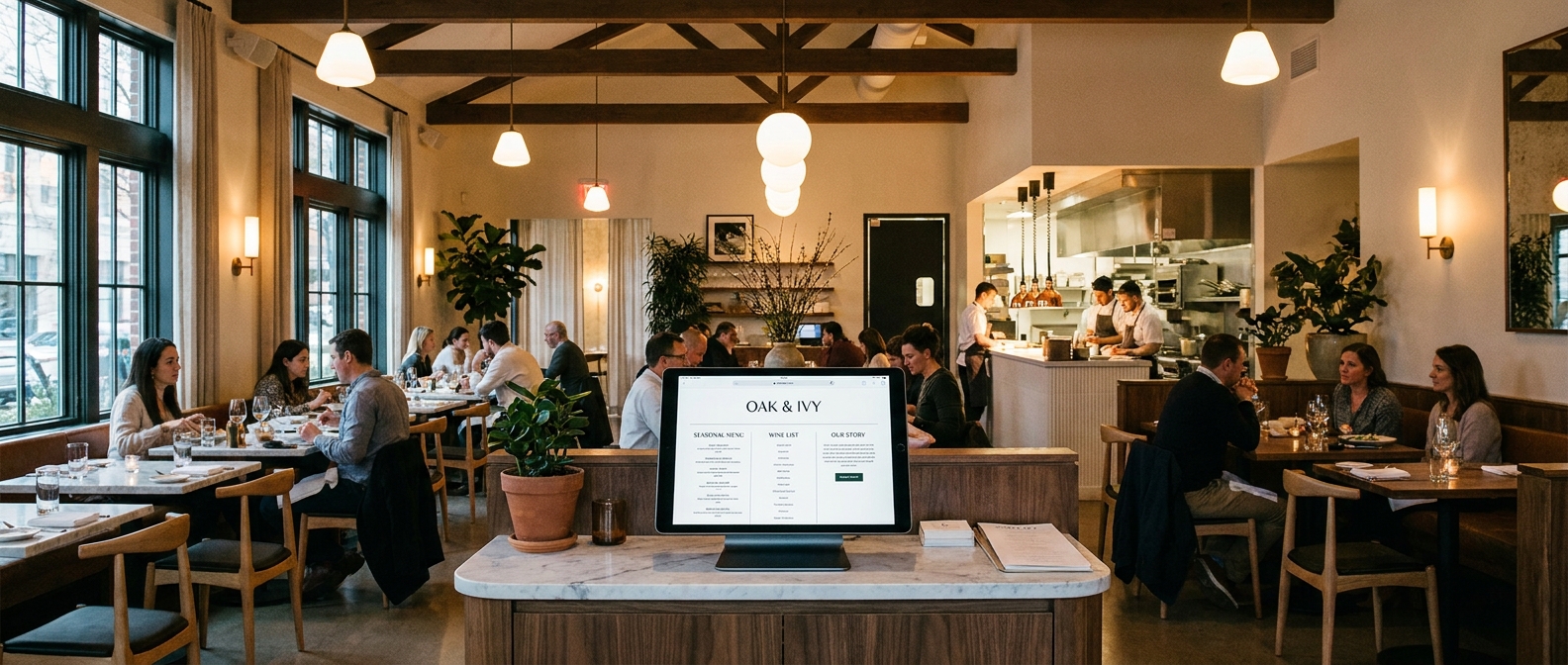
When a hungry diner discovers your restaurant online, your website has about five seconds to answer three basic questions: What kind of food do you serve? Are you open right now? How do I order or get there?
Too many restaurant websites treat web design like an art gallery exhibition. They load auto-playing video reels, oversized branding graphics, and complex multi-page animations that frustrate mobile visitors who just want to check tonight's specials or find your address.
Great restaurant website design is not about flashy effects. It is about removing friction between a customer's appetite and their decision to walk through your door or place an order.
Below, we examine seven real-world restaurant website design examples, break down what makes them effective, and share practical design rules you can apply to your own restaurant site immediately.
---
What Makes an Effective Restaurant Website Design?
Before looking at specific concepts, it helps to understand the core elements that every high-converting restaurant site shares:
| Design Pillar | Why It Matters | Common Failure Point |
|---|---|---|
| Mobile-First Layout | Over 70% of restaurant web traffic visits via smartphone | Multi-column desktop grids that break or crowd small screens |
| Instant Access to Menus | The menu is the single most visited page on any restaurant site | Burying menus inside multi-megabyte PDF downloads |
| Clear Calls to Action (CTAs) | Directs diners immediately to order, reserve, or call | Hiding phone numbers or reservation links in sub-menus |
| High-Quality Food Photography | Appetite appeal drives table bookings and order sizes | Using unedited, dim smartphone photos or sterile stock imagery |
| Up-to-Date Hours & Location | Diners must confirm you are open before driving over | Forgetting to update holiday hours or parking instructions |
---
7 Real Restaurant Website Design Approaches That Win Customers
1. The Single-Page Fast Casual (Clean, Speed-Focused)
Best suited for: Pizzerias, burger joints, taco shops, sandwich delis.
Fast casual spots thrive on impulse decisions and quick orders. Visitors to these sites are rarely browsing for romantic ambiance; they want to know what you make and how quickly they can get it.
Key design elements:
- A sticky navigation bar with three buttons: "Menu", "Order Online", and "Directions".
- Prominent display of current opening hours and today's cut-off time for takeout.
- Direct links into an integrated ordering platform with zero interstitial pop-ups.
Why it works: It respects the customer's time. A hungry diner on lunch break can pull up the page, tap "Order Now", pick their combo, and check out in under two minutes.
---
2. The Neighborhood Bistro (Warm, Story-Driven)
Best suited for: Farm-to-table eateries, local French bistros, wine bars.
Neighborhood bistros sell an experience as much as food. Their website design needs to convey hospitality, craftsmanship, and local community roots.
Key design elements:
- Warm neutral color palettes (cream, warm timber tones, deep olive, or charcoal) rather than harsh neon shades.
- Short introductory statement highlighting local sourcing, culinary heritage, or chef background.
- Clear distinction between dinner, brunch, and seasonal cocktail menus.
Why it works: It sets expectations for the physical dining room. Guests know before arriving whether the room fits a quiet anniversary dinner or a casual weeknight glass of wine.
---
3. The Fine Dining Destination (Minimalist, Elegance-Focused)
Best suited for: Tasting menu concepts, upscale steakhouses, elevated seafood spots.
High-end dining websites often overcomplicate their layouts. The most successful examples do the opposite: they rely on generous whitespace, refined typography, and understated elegance.
Key design elements:
- High-contrast typography paired with large, beautifully styled food photography.
- Direct integration with reservation platforms like OpenTable or Resy, anchored in the primary navigation.
- Clear information on dress code, corkage policy, parking or valet details, and private dining inquiries.
Why it works: It conveys exclusivity and attention to detail. When dishes cost $75 or more, a clean, polished website signals that the kitchen holds itself to the same exacting standards.
---
4. The Craft Brewery & Taproom (Event & Social Centered)
Best suited for: Microbreweries, cider houses, gastropubs with rotating taps.
Taprooms operate differently than traditional sit-down restaurants. Guests care deeply about what is currently pouring, which food truck is parked outside, and whether you are hosting trivia on Thursday.
Key design elements:
- A dynamic, easily updated "On Tap" beer list featuring ABV, IBU, and tasting notes.
- A prominent calendar or weekly schedule for live music, trivia, and food truck rotations.
- Clear venue guidelines: dog-friendly policies, kid-friendly areas, and patio seating availability.
Why it works: Taproom patrons check websites repeatedly. Giving them an accurate, live tap list keeps your regulars coming back week after week.
---
5. The Multi-Location Regional Group (Search & Location Focused)
Best suited for: Growing concepts with 2 to 10 locations across a metro area.
When you run multiple locations, your biggest website risk is sending a customer to the wrong address or letting them place a takeout order at a branch 15 miles away.
Key design elements:
- A location selector right at the top of the homepage allowing visitors to choose their nearest neighborhood store.
- Individual landing pages for each location containing dedicated Google Maps embeds, specific phone numbers, and local hours.
- Location-specific menus that accommodate slight regional pricing or availability differences.
Why it works: It protects search engine rankings through dedicated local SEO pages while preventing confusing order mix-ups.
---
6. The High-Volume Breakfast & Bakery (Morning Rush Optimized)
Best suited for: Bagel shops, artisanal bakeries, breakfast cafes.
Morning spots face high volume in short time windows. Customers are often ordering on their phone while commuting or standing in line outside your door.
Key design elements:
- Bold, easy-to-read price points and item descriptions formatted for fast vertical scrolling.
- Clear visual alerts for daily bake schedules, holiday pre-order cutoffs, and sell-out notices.
- Prominent catering and bulk-order inquiry forms.
Why it works: It channels morning foot traffic efficiently and gives larger office catering clients a straightforward path to book platter orders in advance.
---
7. The Heritage Family Restaurant (Authentic & Community-Rooted)
Best suited for: Multi-generational diners, barbecue pits, traditional trattorias.
Family-owned establishments have something corporate chains can never buy: authentic history. Good design highlights this heritage without looking outdated or neglected.
Key design elements:
- Archival photos of founders or original storefronts alongside fresh pictures of popular dishes.
- Prominent showcase of signature dishes that have remained customer favorites for decades.
- Prominent phone calling options for older regulars who prefer calling in their carryout orders.
Why it works: It reinforces emotional connections with longtime patrons while reassuring new visitors that the restaurant has stood the test of time for good reason.
---
4 Costly Restaurant Website Design Mistakes to Avoid
Even seasoned restaurant owners frequently fall into design traps that hurt sales:
1. Uploading PDF Menus Instead of Real HTML
This remains the single most common mistake in hospitality web design. When you upload a scan or print PDF of your menu:
- Mobile visitors have to pinch, zoom, and scroll horizontally across tiny text.
- Google cannot index individual dish names or descriptions, hurting your ranking for searches like "wood-fired margherita pizza near me".
- Updating a single price requires opening graphic design software, re-exporting the file, and re-uploading it.
Always format your menu in responsive HTML text so search engines and mobile screens can read it effortlessly.
2. Auto-Playing Music or Background Videos
Background video reels consume massive mobile data and slow down page load speeds dramatically. If a customer opens your site in a quiet office or on public transit and music suddenly blasts through their phone speakers, their immediate instinct is to close the tab.
3. Hiding Basic Logistics
Never force visitors to hunt for your street address, operating hours, or phone number. Place these in your header navigation, repeating them clearly in the footer of every page. If you have unique parking arrangements (like an alleyway lot or validation program), spell it out plainly.
4. Directing Online Orders Exclusively to Delivery Apps
If your primary "Order Online" button links directly to third-party delivery marketplaces, you are handing away 20% to 30% of that order value in commission fees. Even worse, those marketplaces collect your customer's email address and will later market your competitors to them. Keep direct ordering front and center.
---
The Fastest Way to Get a High-Converting Restaurant Website
Building a website that balances fast mobile performance, search engine optimization, and attractive visuals does not have to cost thousands of dollars or require weeks of wrestling with DIY site builders.
At Free Restaurant Website, we build custom, fully responsive websites for independent restaurants completely free of charge.
- Done-for-you build: We take your existing menu, logo, and photography and turn them into a fast, modern site.
- Mobile-optimized HTML menus: Easy for diners to read on any phone, and fully indexed by Google.
- Free hosting & custom domain setup: No monthly platform subscriptions, no builder watermarks, and no forced platform ads.
- Optional direct ordering: If you ever want commission-free takeout ordering through SendFoodOrder, we can turn it on seamlessly.
Want to see how your restaurant looks with a modern, high-performing design?
Free Website Offer
Get a modern website for your restaurant with zero cost and no monthly fees
We design and host your menu, hours, and photos on a custom domain. Keep 100% of your food sales, with optional online ordering when you are ready.